
Between Digital Communication and Meaningful Certifications: Interview with Giulia
-
Posted by

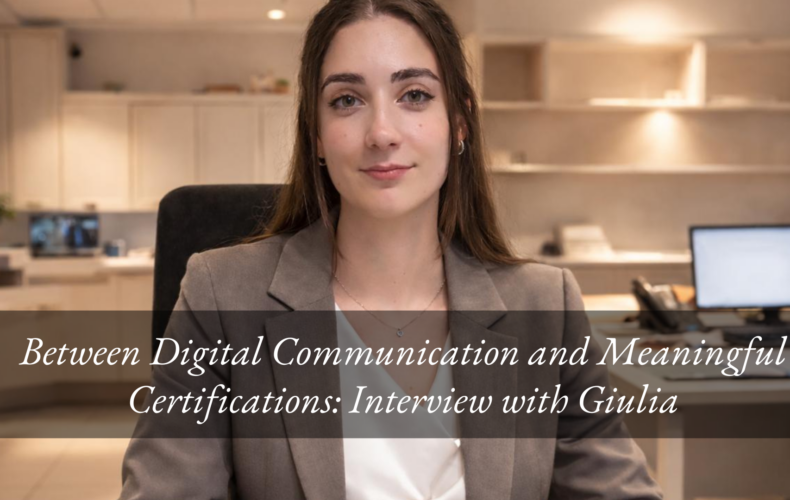
Behind every image, every word and every certification project at the Tritone lies teamwork driven by coherence. We met Giulia, who for the past two years has overseen our communication and digital identity, to understand how thermal tradition translates into a contemporary and responsible language.
Who are you, what is your role, and what path led you here?
My name is Giulia, I am 26 years old and I have been working at Hotel Tritone for about two years, overseeing communication and the hotel’s digital identity. I manage social media channels, campaigns and newsletters, with the goal of conveying the hotel’s philosophy in a contemporary language while preserving its authentic character.
My academic background is in International Relations and Languages, with a focus on marketing. During my studies, I completed several Erasmus programmes and internships abroad — experiences that taught me to observe contexts and people from different perspectives, developing cultural sensitivity, adaptability and attention to detail — essential skills when communicating hospitality.
After an internship in a marketing agency, I approached the world of hospitality, where communication, guest experience and relationships merge into a single language.
Alongside daily communication, I also collaborate on transversal projects, particularly certification and development initiatives that require coordination, attention and shared vision.
You joined Tritone during a period of significant change. How did you experience the opening to social media, and what role does digital storytelling play today?
Opening to social media was both natural and significant. Today, people choose a destination based on what they see online. Instagram has become the first impression — a kind of emotional brochure.
Our objective is not simply to show the hotel, but to convey a style of hospitality. Digital storytelling allows us to express a refined, understated luxury made of atmosphere, rhythm and sensations — where tradition and modernity coexist without losing authenticity.
What details make hospitality unforgettable?
More than a single detail, I would say it is a state of mind. At Tritone, we speak not only of services, but of how one feels during the stay. True luxury is the sensation of being in the right place, at the right pace — when everything feels harmonious and natural, almost imperceptible.
It is an experience remembered not for a specific element, but for the overall feeling it leaves behind.
Why is it important today to certify values, such as Gender Equality?
Declaring values is important; demonstrating them concretely is even more so. Certification means assuming responsibility — ensuring that every individual is valued, protected and placed in the best conditions to express their role.
In hospitality, this directly reflects on the guest experience, because a balanced workplace naturally generates more authentic hospitality.
How did certification change the internal climate?
It brought awareness and structure. Many positive dynamics were already present, but formalising them created greater clarity, dialogue and participation.
When people feel respected and protected, they work with greater serenity. Guests may not see the process, but they perceive the balance.
And what about the environment? How can a thermal resort be truly sustainable without compromising comfort?
Sustainability is not renunciation, but conscious design. It means integrating technology, materials and organisation intelligently.
We use thermal water as an energy resource for heating and recover rainwater for park irrigation. We reduce plastic usage, optimise consumption and select responsible materials in architectural projects.
Every decision is guided by balance: maintaining high standards while reducing environmental impact. True luxury today lies precisely here — offering quality without waste.
How do you protect natural resources such as thermal water and mud?
Thermalism is both scientific heritage and territorial legacy. We collaborate with research and training institutions, including the Pietro d’Abano Thermal Studies Centre, promoting the study of thermal mud and water — from creating a database of microorganisms protecting cyanobacteria responsible for therapeutic properties, to collaboration with the University of Padua in thermal medicine education.
Protecting resources means understanding, studying and transmitting them. Alongside research, daily practice includes responsible water use, guest awareness and careful management of thermal cycles.
The goal is to preserve a natural and cultural uniqueness — not only for today, but for future generations.
Do you bring this harmony into your personal life?
Yes — especially the idea that wellbeing is not only treatment, but prevention. I have learned to value rhythm, time and daily balance. Living well for longer is not accidental; it results from conscious choices and supportive environments.
It is a philosophy I embrace beyond work.
What gives you the greatest satisfaction in your work?
Results, certainly — but not as isolated achievements. Satisfaction comes from knowing they are the fruit of teamwork.
Every department contributes — operations, reception, management — and communication becomes the meeting point of all these energies. When guests perceive this coherence and feel well, communication becomes a tangible experience.
Certification achievements are also deeply meaningful: milestones built over time through collective effort.
What message do you wish to convey today?
Not simply to choose a place where you feel well, but a place that does good.
Today, wellbeing also includes responsibility — toward oneself, toward others and toward the environment. Our goal is to offer an experience that enhances the quality of life without burdening what surrounds it.